
Step 1
Place the packed box on a flat surface.
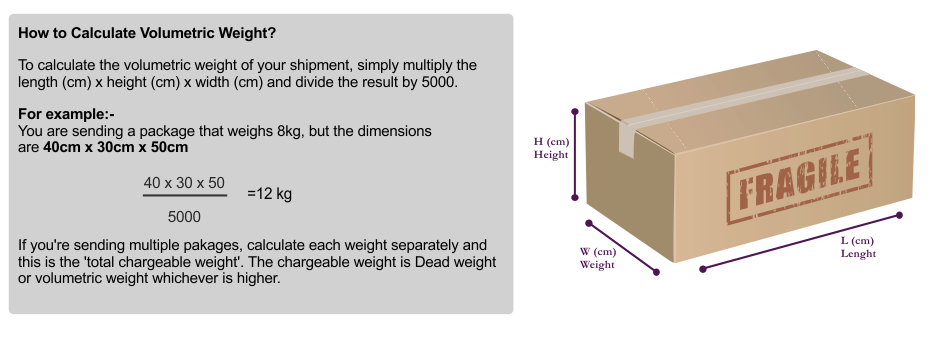
Correct weighing and packaging help avoid wrong courier charges, damage risk and shipment delay. Before booking an international courier or cargo shipment, measure the final packed box, check actual weight, calculate volumetric weight and confirm whether the item needs special packing or documents.
International courier and cargo pricing usually compares two weights:
For a better quote, always share packed dimensions in centimetres along with actual weight.
Volumetric weight is used when a shipment takes more space than its actual scale weight suggests.
| Measurement | Formula or rule | Important note |
|---|---|---|
| Actual weight | Weight shown on weighing scale after final packing | Use the packed parcel weight, not only the item weight |
| Volumetric weight | Length × Width × Height ÷ 5000 | Use centimetres for length, width and height |
| Chargeable weight | Higher of actual weight and volumetric weight | This is commonly used for final courier billing |
| Cargo divisor | May vary by carrier, cargo mode or country route | Confirm the final divisor before booking large cargo |
Measure only after the parcel is completely packed and taped.
Place the packed box on a flat surface.
Measure length from the longest side of the box.
Measure width from the shorter front side.
Measure height from bottom to top after final taping.
Round off dimensions as per courier billing practice where applicable.
Share weight and dimensions with the courier team before final quotation.
Good packaging protects the item and helps avoid unnecessary dimensional weight.
Choose a box that fits the item closely. Oversized cartons increase volumetric weight and may raise courier charges.
Length, width and height should be measured after the box is fully packed, taped and ready for pickup.
Courier charges are usually based on the higher value between actual weight and volumetric weight.
Use bubble wrap, corner protection, fillers and strong outer packing for fragile or breakable items.
Food, medicines, liquids, batteries, electronics and powders should be checked before packing with other items.
Write sender and receiver details clearly and keep invoice, packing list and shipment documents ready.
Different shipment categories need different packing and document checks.
Use a strong document envelope or rigid mailer. Do not fold certificates, legal papers or university documents unless required.
Use a compact carton, avoid empty space and pack items separately inside the box to reduce movement.
Keep medicines in original packing with invoice and prescription. Do not mix medicines with food, liquid or unrelated items.
Use sealed, labelled and non-perishable packs. Avoid liquid, leaking, fresh or homemade wet food items.
Pack clothes, books and personal effects in strong cartons instead of weak bags. Prepare a box-wise packing list.
Use export-worthy packing, invoice, packing list and item description. Fragile or high-value goods need extra protection.
Small packing mistakes can increase chargeable weight or create shipment risk.
Correct documents help prevent pickup and customs delays.
Review the document list required for international courier before pickup.
We will check chargeable weight and suitable packing guidance before courier booking.
Simple answers about actual weight, volumetric weight, chargeable weight, parcel measurement and packing.
For faster support, send item list, destination country, actual weight and box dimensions in centimetres.
Final courier charges, chargeable weight and acceptance depend on carrier rules, destination country, item category, packaging quality and documents.
Do not pack restricted, fragile or high-value goods without review.